Thursday, 14 July 2016

Royal Geographical Society


Okay, a little disclaimer for this post: I wasn’t feeling too hot that day (not helped by the fact it was super humid!), so I didn’t take too many pictures and my notes are a little choppy.

Anyways!

When we went into the library, there were a bunch of artefacts on the table we sat around. Our guide gave us a quick history of the society before telling us about the items themselves. The society was founded in 1830, and in order to be a member, you had to help gather data. To aid with this, the society eventually purchased a variety of scientific instruments for explorers to borrow. Currently, there are 17,000 members, the majority being academics. The archive holds over a million maps, mostly of places Britain has explored but not restricted to that, 4,000 atlases, many globes, half a million images, 250,000 books as old as the 15th century, a sizeable archive, and a small but extremely popular objects collection.

The majority of the items shown to us were from the 19th century, with some from the 20th. Our guide told us the story of various expeditions to find the Northwest Passage, including Inuit “sunglasses” from 1823, and of Sir John Franklin, whose expedition was lost in the 1840s. His wife prompted the Admiralty to start a search for her husband and the other missing men. McClintock was able to find almost every body during his search, but no ships log or record was found, nor were the ships, which remained missing till the 1980s.

Next, attention went to Central Africa, and finding the source of the Nile River. After Lake Victoria was found, there were quite a few who didn’t believe that the lake was the source. This was eventually proven to be true by an explorer sailing another river, one that many believed to be the Nile, and proving that it didn’t end up in Egypt. We were also told the story of Livingstone and Stanley, and were shown the hats that the two wore during the famous “Mr. Livingstone, I presume” meeting.


Statues of Livingstone and Shackleton on the outside of the RGS building


At the end of the century, focus shifted to the Antarctic, and it was deemed by many to be the most important place to explore. The most interesting thing for me in this section is that all of the instruments were modified to withstand the extreme cold. Everything that was made with brass was changed to be made of ivory. Finally, he finished up with the story of George Mallory, who was almost the first man to climb Mt Everest. It’s a pretty interesting (and not short) story, so I suggest you go look it up, and Sir Edmund Hillary.

I suspect I would have enjoyed everything there a lot more if I had been feeling better!

Website

Barbican Library

Part of the Estate
I don’t think I’ve made it a secret how much I love the Barbican Centre and Barbican Estate. There are just as many people who hate the complex of buildings as there are people like me, though. It was opened in the 1980s, but construction on it started much earlier, not long after the area was devastated after World War Two. It’s built in the brutalist style (hence the divide in opinions – a lot of people don’t like that style of architecture, I personally like some buildings and not others), and is honestly a tad bit confusing when you’re inside! There are several entrances and most of the floors of the Barbican Centre are open to the floors above and below in some areas. I had a little trouble finding my way back to a tube station when I was leaving, but that was due to me leaving from a different entrance and there being a large amount of construction in the area. Funnily enough, I found out a couple of weeks later, I could have just walked back to my dorm! The towers of the estate are visible from the tube station that was down the street from the dorm.


On to the library: again, we were split into two groups. In most of the areas we went there was enough room for our whole class, but it’s a working library, so it was easier to be quiet with a smaller group. This library is one of two public libraries in the City of London, the other being at Guildhall. This library is somewhat unusual due to the fact that it’s in the square mile: Only 9,000 people live in the City, while 300,000 work and study there. Because of this, you don’t have to actually live in the City to have a library card there. It also has more men and 25-45 year olds, likely because of the businessmen and women who visit.

Part of the music library
The Barbican Centre is very arts-focused, it’s actually the largest arts centre under one roof in the world, so they have a large arts and music library. The arts section of the library is sorted by type of art – quilting, woodworking, etc. The music library is split between a room with all of the printed materials (books, periodicals (some of which are fairly rare), and scores), and CDs and DVDs in the main library area. Interestingly, BluRay discs aren’t as popular as DVDs. That kinda surprised me, as I’m a big fan of BluRays (and the special features on them!).


The main part of the library (adult, non-fiction, and YA) seems pretty similar to what I have at home book-wise. The YA section isn’t that large, but that’s a space issue, not a choice. One part that was quite a bit bigger than at home was the travel section – I would have loved to see that at home before I left for London! There’s a permanent book sale area, which both libraries I go to have.


There’s also a huge focus on accessibility and helping people out in this library, but I’ve noticed these both are important in the UK. Even though the library is located on different levels, it’s still possible for wheelchair users to get to different areas. There’s also assistance to those learning new skills and languages, as well as services for the elderly and homebound.


The children’s library was the last area my group went into. It was small, but like the YA section, not really by choice. It did have its own room, which allowed kids to be a little nosier than they would be able to in the rest of the library. There are a lot of different programs focused on engaging kids and families, and lots of new clubs as well. The summer reading challenge was just about to start when we visited, which seemed like it acted pretty similarly to the summer reading programs at home. This one just had the perk of a party at Guildhall if you read all the books!


British Museum Conservation Centre


The British Library Conservation center was pretty interesting – it is located in its own building directly behind the main building for the British Library, and if you didn’t see the signs pointing to where it is, you wouldn’t know it was there. The centre itself isn’t generally open to the public, it seemed like tours and employees only, but there was a small exhibit in the lobby about conservation.

The Conservation Centre works on more than just books: the library has hundreds of books of textiles, textiles that are not part of books, paintings, and much more. The first conservator we talked to was working on thousand year old paper manuscripts that were found in caves. For some projects, it’s taken decades for them to be preserved, simply due to limitations in technology.

Next, we were given a demonstration of book binding, and told about difficulties caused by certain types of binding. Many more modern books, including almost all paperbacks, are not as stable and are more likely to fall apart. We were also given the chance to try our hand at binding an example book. I wanted to take a shot at it, but I have a tendency to prick my fingers every time I hold a sewing needle, and I didn’t want to do that in front of all my classmates! The goal for the books that need to be re-bound is for them to be done in the original binding style.

Our next stop was textile conservation. The artefact being worked on here was a flag from the Royal East India Company Volunteers that was in pretty bad condition. When in use, they’d been around open fires, so a special bath had to be used to wash the flags. We were told how the flag had been conserved so far, and the next steps that would be done.


Finally, we were shown part of the Hebrew collections that are being digitized, and the preservation that the items are undergoing before being digitized.

The British Museum

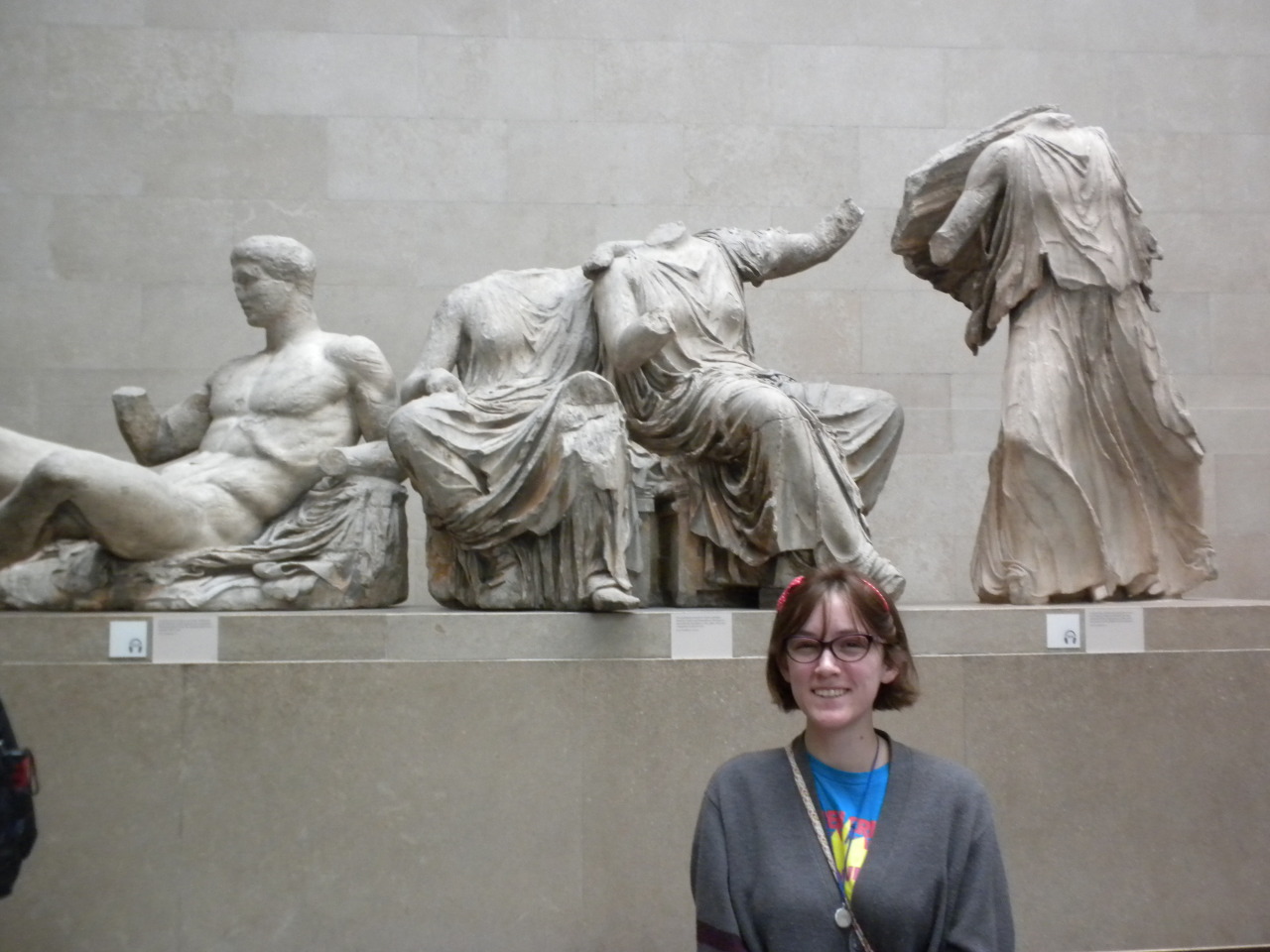
The British Museum archives is probably the place that I’ve been the most excited to see. I’ve been in love with the British Museum ever since I first read about it in The Red Pyramid by Rick Riordan, the first of the Kane Chronicles books. The first few chapters of the book take place in London, including the museum and Cleopatra’s Needle. My love of it was just reinforced by my previous trip to London, where I was able to see the actual Parthenon statues in person for the first time! Naturally, I saw them again this trip J
Me at the British Museum in 2013 and 2016
My class was split into two groups for this tour, as the archives themselves are very cramped. I was in the second group, so we had time to explore the museum before our tour.
The Rosetta Stone
I explored the Egyptian rooms with a few of my classmates, and then darted off to the Greek and Roman rooms to see my favorite part of the museum. After walking through the rooms with the mummies with my eyes closed (I will never ever like mummies!), I ended up at the Japan room, where a few of my other classmates were too! We didn’t have much time after looking through that gallery before our tour started, so we took a quick glance through the gift shop and then we were escorted to the basement to see the archives.
The archives were honestly a lot more disorganized than I expected – to no fault of the current archivist! She is only the second archivist in the museum’s long history, and before her predecessor, things weren’t stored and sorted in the best of ways. Francesca is trying her hardest to reverse centuries of strangeness (that’s the best word I can find to describe it!). There isn’t currently a catalogue to know what exactly else there is – simple due to many original documents being bound in volumes, changes in organization systems, and changes in department names.

Despite some of the problems, the records are still impressive. The earliest record is from 1738, and they still have the meeting notes from the museum’s first meeting of trustees in 1753. An original ticket is in the collection, as well as a guidebook from 1808 – the ticket doesn’t mean that the museum was paid entry though! It simply had a vast collection, and guided tours were given. The guidebooks simplified things a bit, but I suspect guided tours lasted for much longer after the first guidebook was printed.

Like I said in the British Library post, the museum was the library’s former location. To this day, the reading room in the central courtyard is intact, exactly how it was left! We didn’t see it this tour, but I suspect that’s a good thing – it must be dusty! (Or maybe not – they might have it cleaned regularly. I didn’t think to ask!)


My favorite things from this tour: like the Henry Ford back at home, there is still new material being found in the library! They also have records stating the museum’s legal ownership of the Parthenon statues; reading room records from the 1880s, including Bram Stoker’s readers card (!!); and a bit of a bomb that hit the museum during the blitz – it took the museum decades to fully recover from that!


Website

The British Library

Photo courtesy of Dr Welsh

Cool bench near the entrance!

Our third day of class took us to the place most of us were super excited to see: the British Library! The British Library functions in a similar way to the Library of Congress in the States – after the Legal Deposit Act of 1911, the library became a deposit library, meaning everything published in the UK (books, magazines, newspapers, periodicals, etc.) must have a copy submitted to the library. That’s roughly 8,000 items a day!

Before 1973, the British Library was part of the British Museum – the reading room inside the courtyard of the British Museum was part of the library, but I’ll talk more about it in my next post! The building that the library is currently in was commissioned in the early 1960s, but wasn’t opened to the public until 1997. It took four years to move all of the books over to the new building – it’s not too far to the British Museum, but there were millions of books to move! It was designed to be completely environmentally controlled, at roughly 62 degrees Fahrenheit and 50% humidity, with the majority of the book storage in underground reading rooms. The profile of the building is meant to look like a boat – none of us in my group noticed that till we looked at a scale model of the building!
If you want to read a book at the library, you have to apply for a readers card and know specifically what books you need. I didn’t apply for one, as all the materials that’d help me with my paper were digital journal articles and available elsewhere, but many of my classmates did and enjoyed having it. When you request a book, it gets sent to one of many reading rooms in the library for you.

Outside of the main library areas, there were a few interesting things! The lobby and atrium area had two gift shops, an exhibit hall, which currently had an exhibit on Shakespeare, a cafĂ©, a small display area containing an exhibit on the birth of punk, and a permanent exhibit on rare items held by the library – including papers that the Beatles wrote their songs on! There were many more historically significant things there, but I liked the Beatles bit the most J.


Of course, there’s also King George III’s collection: it’s literally unmissable. It’s a giant glass tower in the middle of the lobby/atrium that contains the king’s library. There was a stipulation that the library must be viewable by the public because of its beauty and value, so that’s why it’s in a glass tower. I think everyone in my group had a mini heart attack when our guide was leading us towards the entrance to the tower – but alas, only a few special people are allowed in to the tower. We were all content with just looking at it, though!
Oh, I can't forget the most important thing about this day: I went back to Platform 9 3/4!


Merton College Library


After a free hour for lunch, we headed to Merton College for our tour. It was founded in the mid-1200s, with the hall being built in the 1270s, and the chapel between 1270 and the 1290s. There’s a mix of the original gargoyles as well as Victorian reproductions. Originally, the chapel here was going to be the city’s cathedral, but that honor went to Christ Church College instead.

Many windows in the college used to be stained glass, but were taken out during reformation. Some have been restored by the Victorians – though it doesn’t seem like the windows were put back correctly, a lot of the images are a bit jumbled up. The organ in the chapel is surprisingly modern – it was made two years ago in Iowa!


Throughout the college, we were shown how little of an idea people had of what dolphins looked like –we didn’t know they were dolphins at first!

After the chapel tour and seeing some of the grounds, we went on to the college’s library, which is the oldest continuously used library in the world. The ceiling wasn’t the most impressive of all the ones we saw over the month, but it was still impressive. The bookshelves in the library are the originals from the 15th century, and were a new invention when they were put in!


Aside from the hundreds of books, the library contains quite a few artefacts and noteworthy architectural features. Amongst them are Bodley’s funeral helmet, which is much smaller than any of us expected and was actually the accurate size; A stone tablet from Assyria, “claimed” in the 1920s; astrolabes, sextants, and quadrants, one of which may have belonged to Chaucer; screens designed by Christopher Wren; and floor tile from a 17th century Benedictine abbey.

Wednesday, 13 July 2016

Bodleian Library


On our second full day of classes, we went to the beautiful city of Oxford! I’d been before on my last study abroad trip, but seeing inside the colleges was much more impressive and memorable than the walking tour we did last time. It was also much cooler (it actually sprinkled a little bit towards the end of my time there), which I appreciated!
Our first stop of the day was at the Bodleian library. It was opened in the 1300s, and holds the honor of being the first library in the city of Oxford, though it wasn’t opened to students until the early 1400s. Not long after the library opened to students, the divinity room was deemed necessary, and the first stone was laid in 1427. The original architect, who died partway through construction, was extremely experienced and was permitted to add decorative touches to the windows and other areas. His replacement, however, wasn’t as skilled, and wasn’t allowed to make those decorative touches – and you can tell! It’s still a stunning building, but you can tell there was more than one architect. The pendants and bossets on the ceiling were carved on the ground before being installed, and the plaques on the ceiling were inspired by nature and religion, as well as being the coats of arms of the donors. Much later, Christopher Wren, a professor at Oxford, added to the room and slightly changed the architectural style of the room.
If it seems like I’m blabbering on about this… there’s a reason: this room was the hospital wing in the Harry Potter movies!


The next room we went to was Convocation House. It has beautiful wood seating which is surprisingly not original! It was used as a meeting room for Parliament in the 17th century by Charles the I. and later by the House of Commons.
After that, we went to Chancellors Court – home of Oxford University’s own court. Students, employees, and privileged persons were tried here, until it ended its life as a debtors court in 1968. One of the most famous people tried here? Oxford Wilde, in the 1870s.
Following that, we went in to the Bodleian library itself. While the library has been reorganized to include many libraries, the one we visited is the oldest: Lord Humphrey’s library. Many of the original books in this library were donated by Lord Humphrey, though not all remain due to declines and rises over the library’s history. In the early 1600s, Thomas Bodley restored the library. Not long after that, an agreement was made where the library would become a copyright library. To this day, the Bodelian is one of several libraries in the UK that receive a copy of every item published in the UK. It’s also a purely research library – nobody can be leant a book, not even royals. Books haven’t been chained for several hundred years, but they are sorted by size. That’s not something I was expecting!

Funny story we were told: The library has a copy of Shakespeare’s 1st and 3rd folios. The first went missing pretty early – only to be discovered in 1903 in the family library of one of the university’s students!

This ended up a little longer than I expected, so my next post will cover the Merton College library!

Website